


Key points
Investigates the association between exposures to ambient air toxicants and the risk of ALS using EPA data.
Affiliate
Fan Wu [1], Angela M Malek [2], Jeanine M Buchanich [3], Vincent C Arena [3], Judith R Rager [4], Ravi K Sharma [4], John E Vena [2], Todd Bear [5], Evelyn O Talbott [6]
- Department of Environmental and Occupational Health, School of Public Health, University of Pittsburgh, Pittsburgh, PA, United States.
- Department of Public Health Sciences, College of Medicine, Medical University of South Carolina, Charleston, SC, United States.
- Department of Biostatistics, School of Public Health, University of Pittsburgh, Pittsburgh, PA, United States.
- Department of Epidemiology, School of Public Health, University of Pittsburgh, Pittsburgh, PA, United States.
- Department of Behavioral and Community Health Sciences, School of Public Health, University of Pittsburgh, Pittsburgh, PA, United States.
- Department of Epidemiology, School of Public Health, University of Pittsburgh, Pittsburgh, PA, United States.
Summary
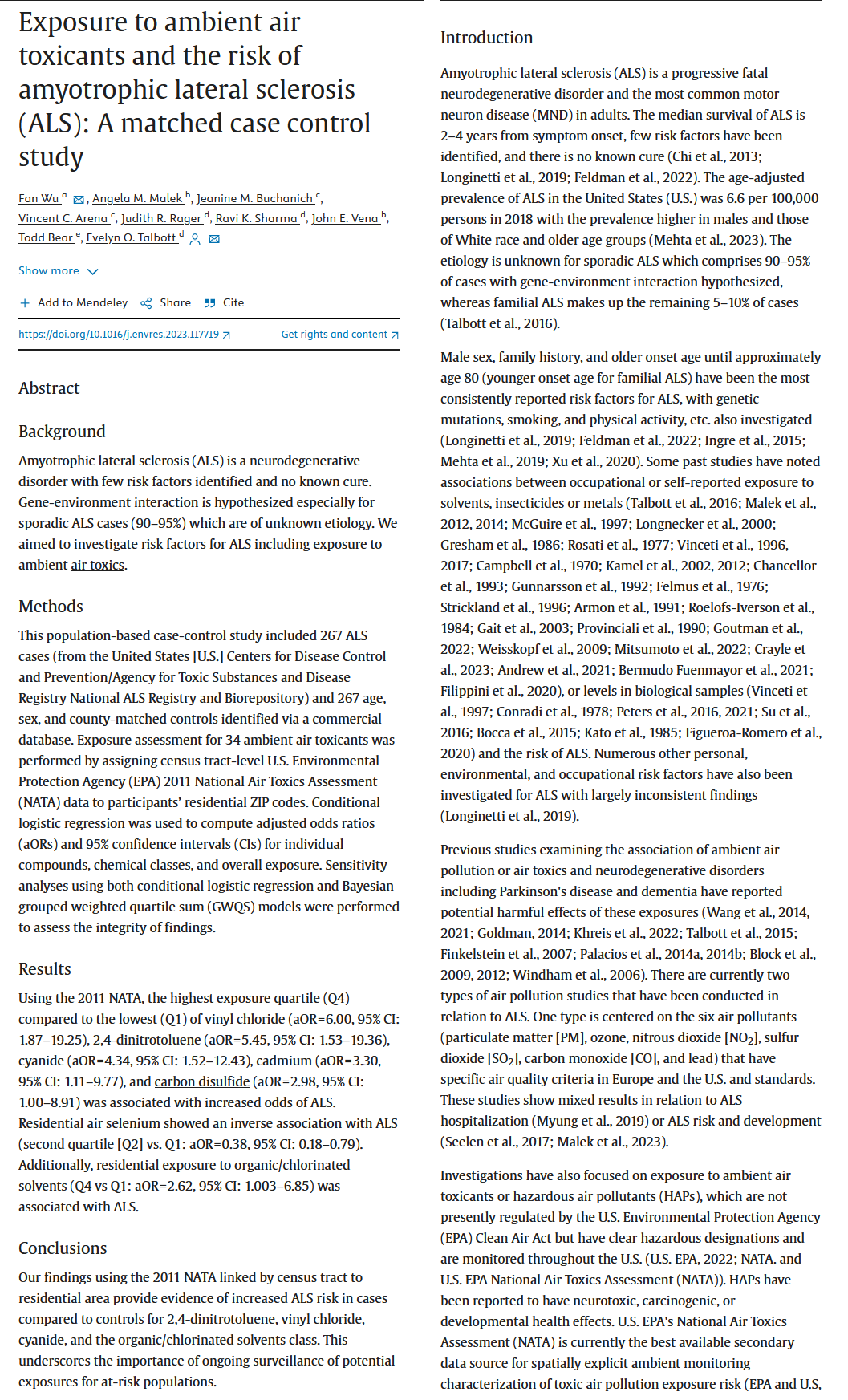
This paper from the University of Pittsburgh investigates the association between exposures to ambient air toxicants and the risk of ALS. Specifically, the researchers identified 34 individual compounds and performed exposure assessments by assigning census-tract level data from the EPA’s 2011 National Air Toxics Assessment (NATA) to participant zip codes. The assessment found evidence of increased risk of ALS in cases compared to controls for 2,4-dinitrotoluene, vinyl chloride, cyanide, and the organic/chlorinated solvents.