


Key points
Proposes the use of capture-recapture, an alternative statistical method, to estimate under-ascertainment in the collection of ALS data for a disease registry in Ohio
Affiliate
Meifang Li [1], Xun Shi [1], Jiang Gui [2], Chao Song [3], Angeline S. Andrew [4], Erik P. Pioro [5], Elijah W. Stommel [4], Maeve Tischbein [4], and Walter G. Bradley [6]
- Department of Geography, Dartmouth College, Hanover, NH, USA.
- Department of Biomedical Data Science, Geisel School of Medicine at Dartmouth, Hanover, NH, USA.
- HEOA Group, West China School of Public Health and West China Fourth Hospital, Sichuan University, Chengdu City, Sichuan Province, China.
- Department of Neurology, Geisel School of Medicine, Dartmouth-Hitchcock Medical Center, Lebanon, NH, USA.
- Section of ALS and Related Disorders, Cleveland Clinic, Cleveland, OH, USA.
- Department of Neurology, Miller School of Medicine, University of Miami, Miami, FL, USA.
Summary
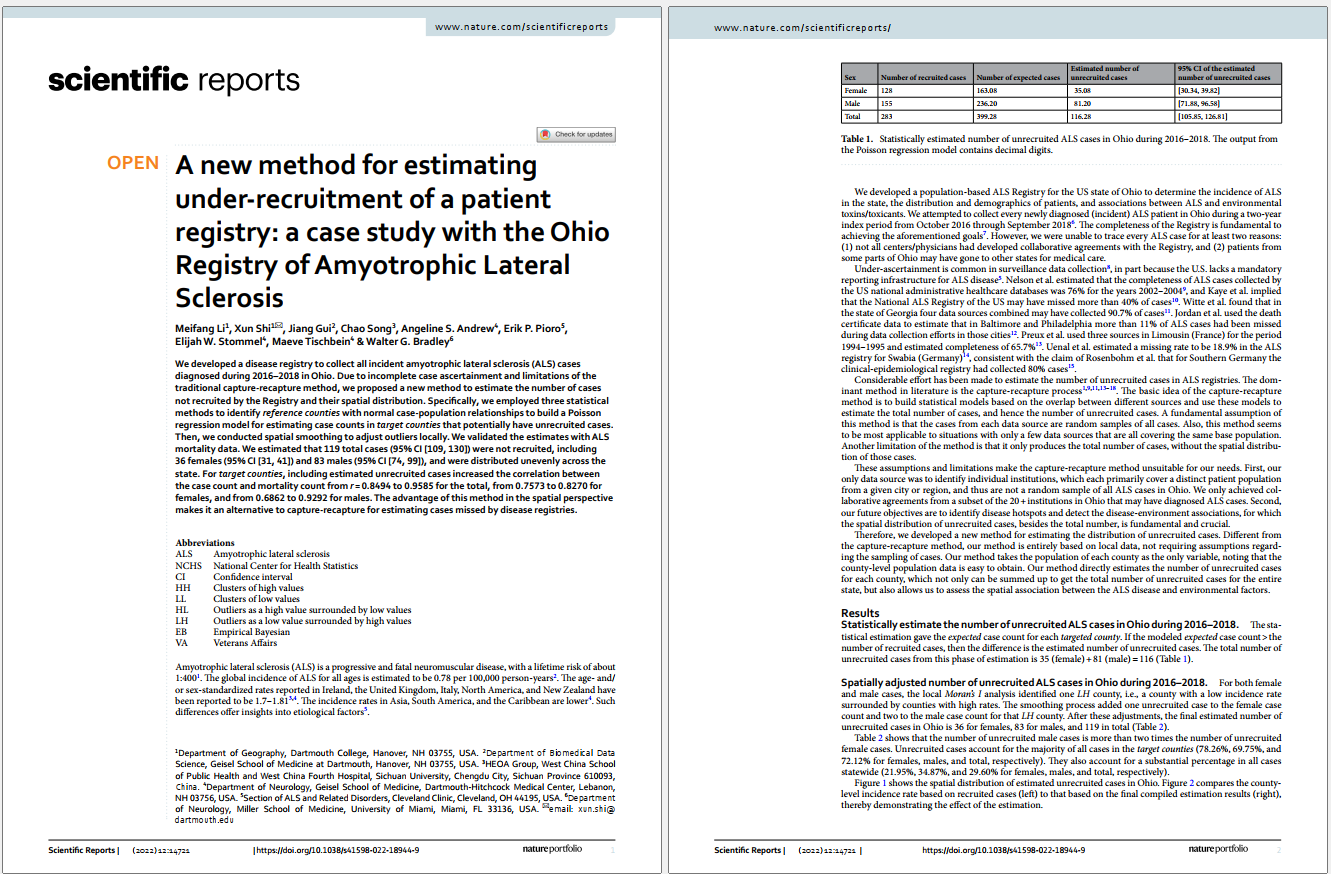
This paper proposes an alternative statistical method to capture-recapture in order to estimate under-ascertainment in the collection of ALS data for a disease registry in Ohio. The study utilized three statistical methods (z-score, straight section in a series, and Jenk’s natural breaks) to identify reference counties in Ohio with normal case-population relationships to build a model to estimate case counts in target counties with unrecruited cases. The researchers believe that this method has advantages over capture-recapture that allow it to be used to identify disease hotspots and associations between ALS and environment.